
Taking elderly parents for Hajj or Umrah
The short answer. Pakistan's Hajj policy requires health fitness evidenced by a medical certificate from a Registered Medical Practitioner, will not permit terminally ill patients to travel on any pretext, and requires a person with a disability or special need to be accompanied by a designated attendant. Beyond the paperwork, three decisions do most of the work: how far the hotel is from the Haram, which month you go in, and whether you have arranged a wheelchair before you arrive rather than after.
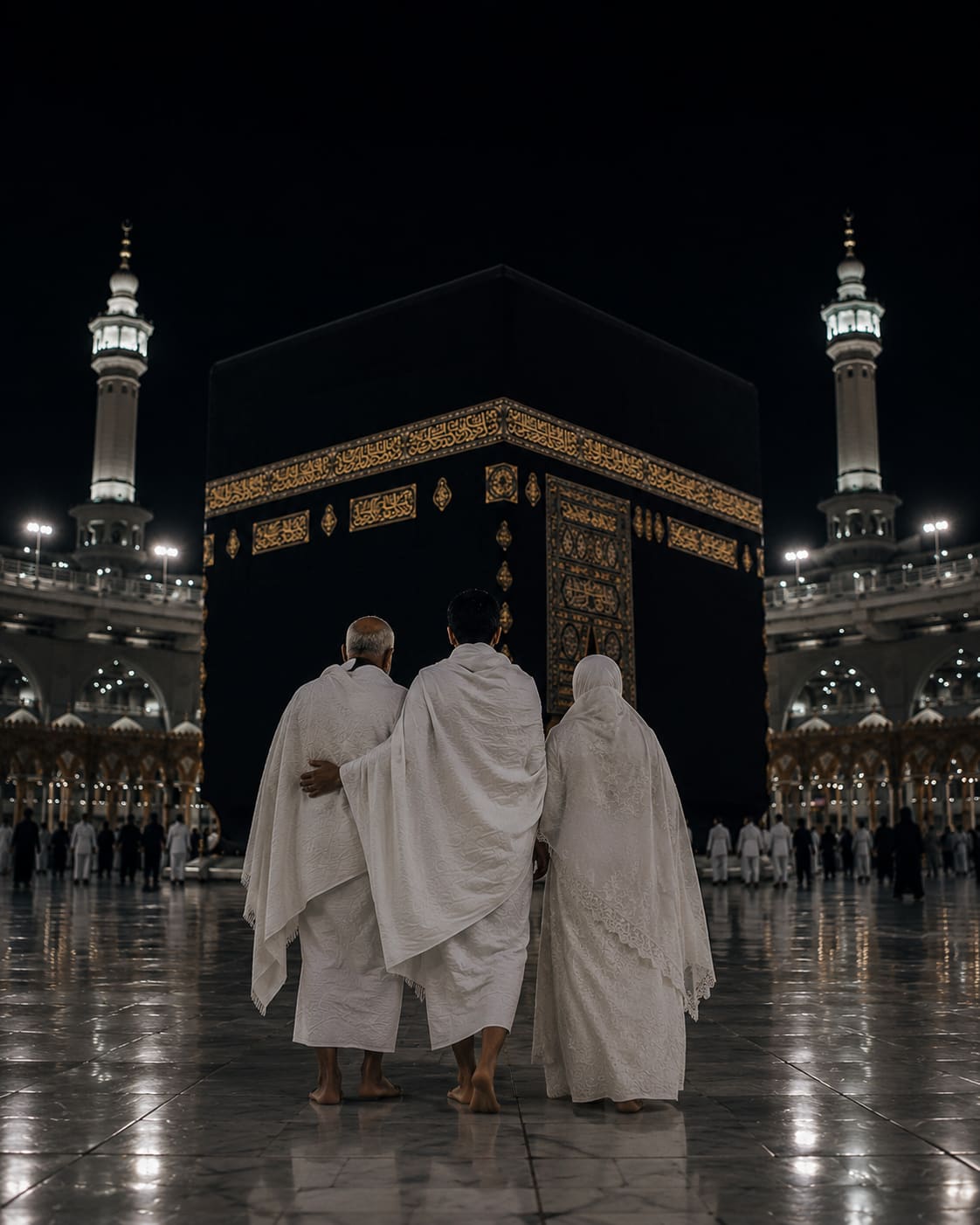
Most people who walk into our office in Saddar are not booking for themselves. They are booking for a mother, or a father, or both, and they have been saving for it for years. It is the best kind of booking to be asked for and the easiest one to get wrong, because the things that decide whether an eighty year old finishes their Umrah comfortably are not the things on the front of a brochure.
Here is what to settle, in the order it matters.
First, the paperwork, because it can stop the trip
For Hajj under either the government or the private scheme, Pakistan's policy sets out mandatory conditions, and three of them concern anybody travelling with an older or unwell parent.
Health fitness has to be proven, not asserted. All mandatory health conditions in the Saudi Taleemat must be met, and only applicants who meet them are permitted to proceed. Fitness is evidenced by a medical certificate issued by a Registered Medical Practitioner in Pakistan. Get that appointment early. If there is a problem, you want to know in a doctor's room in Karachi and not at a counter.
Terminally ill patients are not permitted. The policy says so plainly, and adds "on any pretext". We have had to explain this to families at the hardest possible moment, and it is far kinder to say it here. If a parent is terminally ill, this is not a matter of finding a more willing agency.
A disability or special need requires a designated attendant. Not a suggestion, a condition. If your father uses a wheelchair, somebody is nominated to be with him and that person's booking is part of the arrangement, not an afterthought. Decide early who it is, because it is usually the one family member who was planning to stay behind.
Age itself is not a fixed rule from Pakistan's side. Age restrictions are those prescribed by the Saudi authorities for each season and notified accordingly, so a number somebody quotes you as permanent is a number from a previous year.
Then the one thing worth spending money on
If you take one thing from this page: pay for the distance, not for the hotel.
A five star hotel nine hundred metres from the Haram and a plain one at two hundred metres are not the same trip for a seventy five year old. They are barely the same activity. The difference is measured in five prayers a day, each of which is a walk out and a walk back, through a crowd, often in heat, often at night.
Nine hundred metres sounds like nothing when you read it in an air-conditioned office. Multiply it by ten journeys a day for a fortnight and it becomes the reason your mother stops going to the Haram and prays in the room instead, which is not what you saved for.
Two further points people miss:
- Distance is not the same as walking time. A hotel that is close as the crow
flies can still mean an underpass, a security queue, a road crossing and a long
ramp. Ask how long the walk takes, not how far it is, and ask which gate it puts
you at.
- A room facing the Haram is a luxury; a short walk to it is a necessity. If the
budget forces a choice, choose the walk.
The month, which decides the heat
The second lever is when you go, and for an older traveller it matters more than for anybody else, because heat is not an inconvenience at that age, it is a risk.
Ramadan is the most rewarded and the most crowded, and crowding is its own hazard for somebody unsteady on their feet. The school holidays are busy and expensive. The quiet months outside Ramadan, Hajj season and the school breaks are cheaper, calmer, and often hotter, which is a genuine trade rather than a free win.
For a first Umrah with parents, a quiet month outside the worst of the heat is almost always the right answer, and it is usually also the cheapest one, which is a rare alignment. We went through each month in when to go for Umrah.
Arrange the wheelchair before you go
Wheelchairs are available at the Haram, both the manual ones and the electric carts on the upper level, and there are attendants. This is not something to discover on arrival at two in the morning with a tired parent.
Settle before you travel: whether your parent needs one for the whole trip or only for tawaf and sa'i, who pushes it, whether you want an electric cart for the tawaf specifically, and what that costs. Also ask your agency, plainly, whether they book these or whether "it is available there" is the whole of their answer. Those are two very different levels of service and only one of them helps you at 2am.
The same applies to Madinah, where the walk from a hotel into the Prophet's Mosque and then to the Rawdah is longer than people expect, and where the Rawdah itself now runs on timed permits through Nusuk.
The unglamorous list that actually helps
- Medication, doubled, in hand luggage, with the prescription and the generic names
written down. Brand names differ between countries.
- A one-page medical summary in English. Conditions, medicines, doses, allergies,
blood group, and your number. Put a copy in your parent's bag as well as your own.
- Their own phone, charged, with your number saved in large type, and a written
card with the hotel name and address in Arabic. People do get separated in that
crowd, and a card outperforms a panicking memory.
- Shoes, not sandals, and a bag for them. Marble is hot and slippery.
- Plan for fewer visits, not more. Two comfortable prayers at the Haram beat five
exhausting ones, and nobody needs to be told that by their son.
- Go early for tawaf, or late. The hour matters more than the day.
What to ask an agency
Four questions, and they are not about the hotel's star rating.
- How long is the walk from the hotel door to the Haram, and to which gate?
- Do you book wheelchairs and carts, or only tell me they exist?
- Who is your person in Makkah, and what happens if my father is unwell at night?
- If a medical certificate turns out to be a problem, what happens to the money?
That last one is the one nobody asks and everybody should. Ask it before you pay, and get the answer in writing.
We have been sending families from Karachi since 1984, and a good part of what we do is exactly this: somebody's parents, and the care you would want for your own. If you would like us to look at what you are considering, send it on WhatsApp.
Read next: when to go for Umrah and what Umrah from Karachi actually costs. Our Umrah and Hajj packages are on the services page.
Conditions above drawn from: Hajj Policy and Plan 2027–2030, Ministry of Religious Affairs & Interfaith Harmony
Health and age requirements are notified season by season. Confirm the current position before you rely on anything here, and take medical questions to your parent's own doctor.